Charcoal making experiment
Over the weekend of 31 Jan-1 Feb 2010, we dug a pit that had similar
dimensions to the ones found along Germany Beck, to see how these pits would
work. We really wanted to know if they could have been producing charcoal in
a few days.
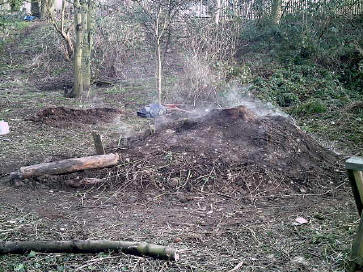 |
Below this heap is a 2m circular hole that was 80cm deep.
Once it was well alight the fire was covered in leaves and think wood so
that it could be covered in soil.
The log on left marks the channel that allowed a little air to enter at
the bottom of the burn. |
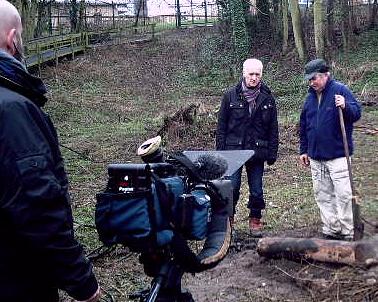 |
The BBC was there to record events. Terry Deary, author of
the Horrible Histories books, was making a programme. We were able
to rake charcoal out, via the air intake, within 12 hours of light-up. So it
would be possible use a pit to make charcoal quickly enough for any
recycling work after the battle. |
A short video showing the digging, building, lighting and management of the
fire will be on UTube very soon.
The BBC film was shown on Monday 15 February 2010 as part of the
Inside Out show.
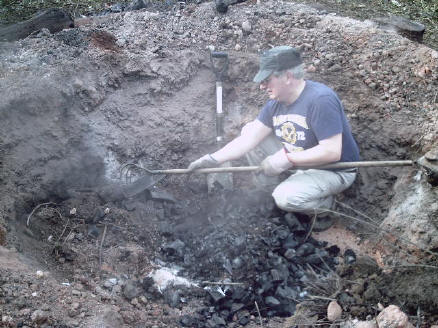 |
Raking out the last of the charcoal. As a part of the
experiment charcoal had been extracted during the 'burn'. Water was poured
over the charcoal as it was not easy to spot in the photos - so that is
steam rather than smoke rising. |
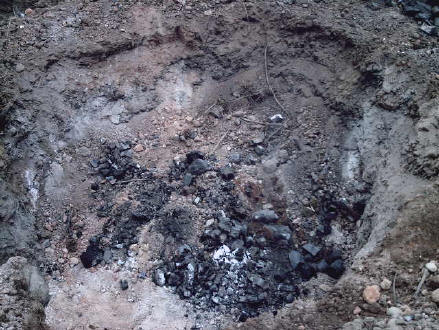 |
This is the pit at an earlier state of excavation. Charcoal
had been taken from top-right and bottom-left leaving only the central area.
The pit was still hot and there is evidence that rather more burning took
place to judge by the amount of ash. But the amount of quality charcoal
produced was excellent with whole logs charred. |
Since this experiment, the report on may charcoal pits from Norway that was
published in 2007 has been seen. Details will follow.